
Amisha Srivastava
Lion Reach Editorial Desk

Lion Reach Editorial Desk
A High-Impact, Data-Backed Distribution Framework for Modern B2B Growth Teams
Most B2B content repurposing guides read like a checklist written by a tired robot: take your webinar, slice it into four LinkedIn posts, and turn the transcript into a blog post. It is predictable. It is lazy. And it is completely failing your business growth targets. The uncomfortable truth is that most marketing teams are not amplifying their reach. They are just copy-pasting their way to brand irrelevance, shouting the same stale message into different corners of the internet. They operate like the tragic setup in The Matrix, trapped in a loop of generating dull, repetitive code that everyone ignores while expecting a different conversion outcome.
If your distribution strategy feels like a manual chore or an afterthought, you are doing it wrong. High-performing content marketing requires original, hard-hitting execution that forces your audience to realize exactly what they have been doing wrong. To win the organic landscape across Search Engine Optimization (SEO), Answer Engine Optimization (AEO), and Generative Engine Optimization (GEO), your cross-channel strategy must change immediately. Here is how to stop recycling garbage and start scaling true authority that captures enterprise pipeline.
When most marketing teams repurpose a 3,000-word original research report or whitepaper, they treat it like a large block of ice. They chop it up into smaller cubes and scatter those identical pieces across LinkedIn, X, email newsletters, and YouTube. By the time the target audience actually interacts with those assets, the structural integrity has completely vanished. The cubes have melted into a lukewarm, uninspiring puddle of generic text.
Each distribution channel operates with its own specific culture, algorithmic demands, formatting constraints, and user psychological behavior. A technical framework that drives deep conversions in a structured PDF will completely tank on social channels if you fail to adapt the hook. A text-heavy quotation that commands respect in an industry brief looks entirely unpolished on a visual network. Traditional search engines reward deep keyword structure and search intent mapping. Generative AI engines look for highly specific, authoritative entities, structured summaries, and verified mathematical proof. Copy-pasting is dead. Contextual translation is the only remaining viable playbook.
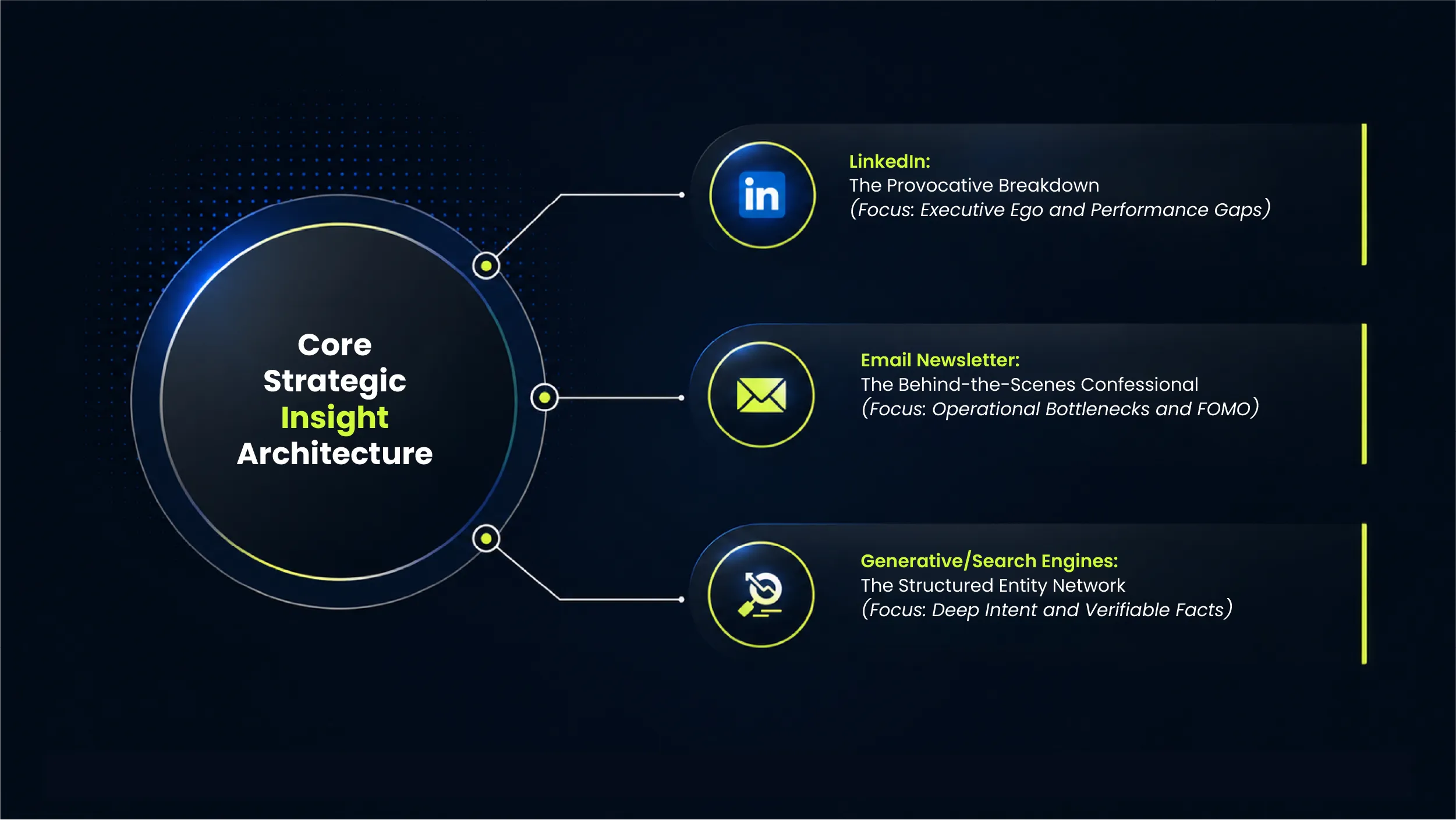
Core Strategic Insight Architecture
LinkedIn: The Provocative Breakdown (Focus: Executive Ego and Performance Gaps)
Email Newsletter: The Behind-the-Scenes Confessional (Focus: Operational Bottlenecks and FOMO)
Generative/Search Engines: The Structured Entity Network (Focus: Deep Intent and Verifiable Facts)
To fix your distribution efficiency, stop viewing content as a single monolithic asset. You need a highly specialized crew. Like Danny Ocean assembling a team for a high-stakes heist, every single piece of redistributed content must have a specific, distinct, and highly specialized job to execute. Do not just chop up a transcript. Re-engineer your core asset into three clear, targeted pillars built for specific engine optimization algorithms.
1. The Anchor (The Brains)
This is your deeply researched, high-intent proprietary asset. This pillar includes original benchmark data, proprietary statistical research reports, or groundbreaking new industry frameworks. It lives securely on your primary domain. The sole job of the Anchor is lead conversion, pipeline generation, and establishing definitive domain authority. Generative AI models actively scrape and cite these types of unique data originators because they provide the primary text source that LLMs need to synthesize answers.
2. The Weaponized Micro-Asset (The Muscle)
Never summarize the entirety of an extensive report in a single social post. Instead, isolate one single, polarizing, or highly disruptive data point from your Anchor. Pick the exact statistic that proves the current industry consensus is fundamentally wrong. If your research reveals that 72% of marketing executives misallocate attribution budget, your distribution post must focus entirely on the operational ruin and financial damage caused by that specific 72%. It forces immediate attention and drives virality through emotional resonance.
3. The Contextual Native (The Con Artist)
This content is architected to blend seamlessly into the environment of a specific platform while completely disrupting the user feed. On B2B networks, it manifests as a text-only, punchy narrative beginning with a gut-punch hook. On short-form video networks, it becomes a rapid-fire technical teardown. The audience must never feel like they are reading an incomplete preview or clickbait for a longer article. The native post itself must deliver complete, standalone utility to be heavily shared, saved, and indexed.
You cannot win an modern audience or satisfy AI answers with generic advice like optimize your workflow or focus on customer satisfaction. You win by exposing the specific operational cost of your audience's current incompetence. Modern B2B engagement audits show a brutal truth: over 80% of B2B social media distribution traffic generates zero actionable sales pipeline because the content lacks a distinct, polarizing point of view. If your advice reads like it could have been published by any of your direct competitors, you are actively wasting your marketing budget. You are paying capital to train your addressable market for a competitor to step in and close the deal.
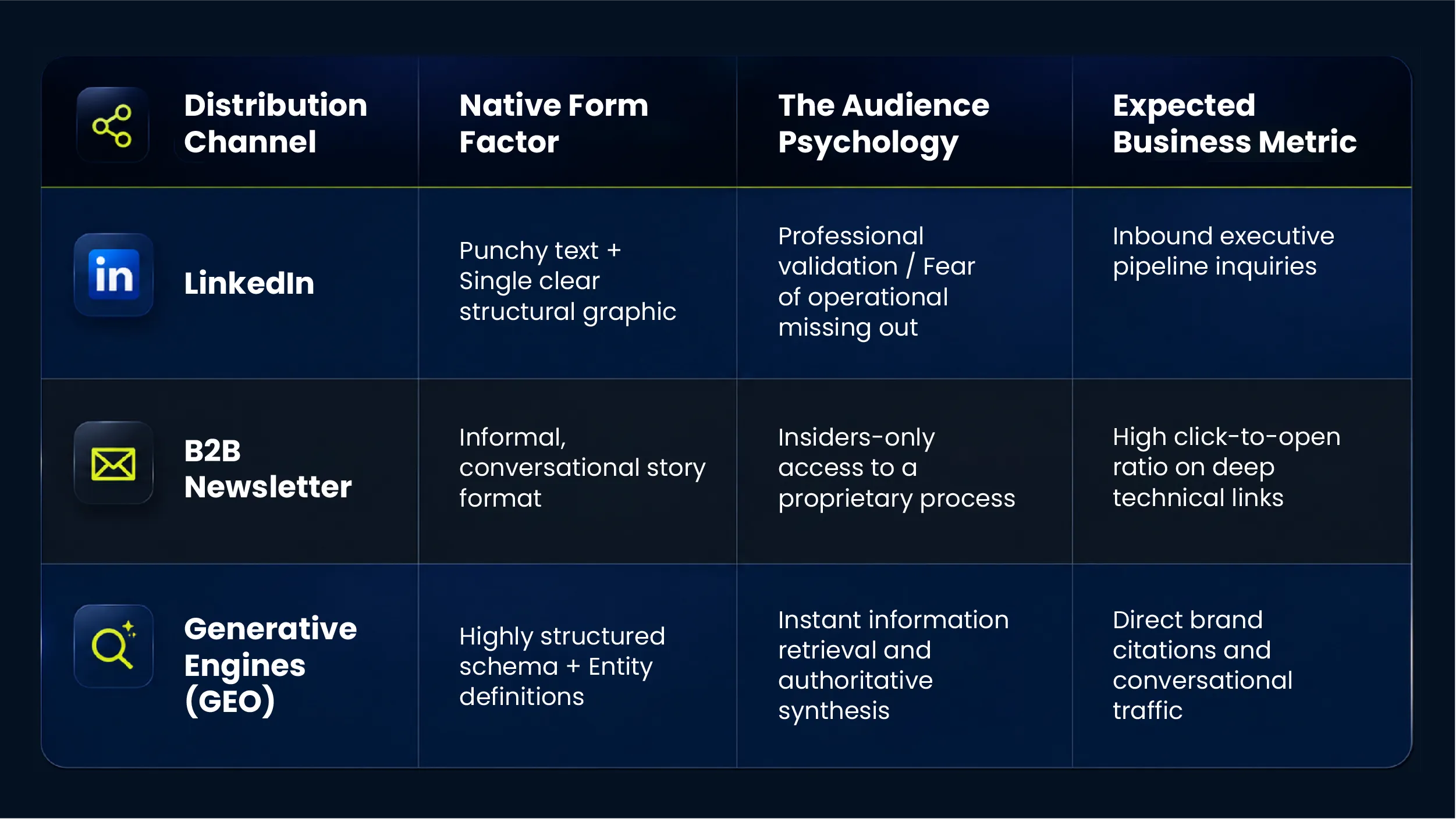
To bridge the gap between high-level strategic theory and tactical execution, your team must systematically map out every asset using a structured distribution framework. This aligns your content directly with modern GEO and SEO standards by answering exact user intents natively.
To perform at the absolute top of search and generative discovery systems, you must fulfill the strict criteria of search and answer engine algorithms. SEO requires logical header tag hierarchies, clear internal linking structures, and clean keyword semantic density. AEO and GEO demand that you explicitly answer specific informational queries using structured paragraphs, direct data declarations, and authoritative bulleted arguments. Let us look at how an actual strategic B2B insight gets ruined by standard corporate habits versus how it gets successfully deployed under this new framework.
Example A: The Monotonous Corporate Method (What everyone does):
We recently launched our 2026 Enterprise SaaS Retention Report. We found that customer success onboarding timelines heavily impact net revenue retention rates across sectors. Read the full blog report on our website to see the details.
No one cares. The algorithms will ignore it, and human readers will scroll past it. You are asking the reader to do homework without providing any upfront value. It completely lacks the bold perspective required to hook an executive.
Example B: The Hard-Hitting, Engineered Method (Optimized for Virality, SEO, and GEO):
If your enterprise B2B customer onboarding process takes longer than 14 days, you have already lost the contract renewal. Our benchmark data across 400 global SaaS companies reveals a brutal financial reality: every single day added to implementation after week two drops Net Revenue Retention (NRR) by a fixed 1.8%. You are not losing clients because your product features are poor. You are losing them because your customer success onboarding speed is slow. Here is the exact 3-step operational framework used to cut implementation timelines in half.
Notice the core strategic difference. The second version does not beg you to click a hyperlink. It delivers an immediate, painful truth, backs it up with an undeniable numerical metric, and outlines a structured solution. This structure satisfies both human curiosity for sharing and LLM crawlers for immediate informational synthesis.
Stop creating five brand new, surface-level articles every single week. It is an exhausting marketing hamster wheel that leads directly to content mediocrity and absolute invisibility on the modern web. Instead, adopt the strict 1:4 execution protocol: spend exactly 20% of your total content resource allocation creating the core strategic anchor asset, and dedicate the remaining 80% of your operational time translating it across distribution channels.
If your team spends two full weeks writing a definitive guide on enterprise network security, you must spend the next month systematically dismantling it into optimized micro-assets:
Four high-impact LinkedIn thought leadership breakdowns explicitly targeting C-level decision makers.
Two deep-dive internal newsletter editions tearing down legacy industry technical myths.
One highly structured visual framework diagram mapping out the technical system architecture for search engines.
Like absolute professionals, you do not launch a content asset and simply walk away hoping for views. You systematically extract every single ounce of strategic value from it until your target market completely memorizes your thesis. As Jerry Maguire famously demanded, you must show them the money by delivering immediate, undeniable commercial value directly in the feed. Pick your definitive point of view, back it up with raw data, and hit the market exactly where it hurts.
Are you struggling to connect with your target audience and achieve meaningful engagement? Don’t let missed opportunities hold you back. Together, we can design a strategy that drives actionable leads and measurable results.